Lending

Lending protocols form the backbone of the decentralized money market, allowing users to lend or borrow digital assets without intermediaries. Using smart contracts, platforms like Aave and Morpho automate interest rates based on supply and demand while requiring over-collateralization for security. The 2026 lending landscape features advanced permissionless vaults and institutional-grade credit lines. This tag covers the evolution of capital efficiency, liquidations, and the integration of diverse collateral types, including LSTs and tokenized RWAs.

14461 Articles
Created: 2026/02/02 18:52
Updated: 2026/02/02 18:52

OnRe Introduces Points Program Rewarding ONyc Participation Across DeFi

OnRe Introduces Points Program Rewarding ONyc Participation Across DeFi

Hamilton, Bermuda, 11th September 2025, Chainwire

Author: Blockchainreporter
Decentralization Diehards Unite in Their Critique of Corporate L1s Like Tempo

Decentralization Diehards Unite in Their Critique of Corporate L1s Like Tempo

The post Decentralization Diehards Unite in Their Critique of Corporate L1s Like Tempo appeared on BitcoinEthereumNews.com. Web2 firms are betting on their own blockchains, but many web3 industry leaders are questioning the move away from Satoshi Nakamoto’s vision and ethos. A wave of corporate blockchain networks is gathering on the horizon, promising faster stablecoin payments and smoother adoption. The long-awaited vision of companies embracing blockchain tech seems to be finally taking shape, but not in the way many crypto veterans expected. Payments giant Stripe, backed by crypto VC firm Paradigm, is building its own Layer 1 chain, Tempo, for global payments, choosing to build the network from scratch instead of making another Layer 2 on Ethereum. Circle, one of the largest stablecoin issuers, is also developing its own L1 for its stablecoin, while Google is working on its own chain, though it won’t be targeting retail users like the other two. Yet, despite big names behind the initiatives, the decisions have drawn wide criticism from some in the crypto community, who say corporate chains move away from the open, decentralized vision Bitcoin’s creator Satoshi Nakamoto had in mind. L1 vs L2 Debate Stripe and Paradigm’s Tempo stands out among corporate L1s in that the team behind it has made an effort to present the protocol as a more open, public-focused network, compared to product-specific chains like Circle’s Arc or Google’s GCUL. Unlike competitors, Tempo is positioning itself as a “neutral platform with respect to stablecoins, allowing users to make transfers and pay gas fees in any stablecoin,” according to a post from Tempo’s official X account. Matt Huang, co-founder and managing partner at Paradigm, said in an X post on Sept. 6 that the plan is to have “permissionless validation and permissionless smart contract deployment,” drawing comparison with Bitcoin, Ethereum and Solana. Anurag Arjun, co-founder of modular blockchain infrastructure project Avail, as well as a co-founder…

Author: BitcoinEthereumNews
Best Presales to Buy as SEC Delays Most ETFs: HODLing Might Be Better Now

Best Presales to Buy as SEC Delays Most ETFs: HODLing Might Be Better Now

The SEC has delayed its decision on BlackRock’s staking application for its spot ETH ETF and Franklin Templeton’s ETF applications tracking SOL and XRP.

Author: Brave Newcoin
Project 0 Launches First Multi-Venue, DeFi Native Prime Broker on Solana

Project 0 Launches First Multi-Venue, DeFi Native Prime Broker on Solana

The post Project 0 Launches First Multi-Venue, DeFi Native Prime Broker on Solana appeared on BitcoinEthereumNews.com. Press Releases are sponsored content and not a part of Finbold’s editorial content. For a full disclaimer, please . Crypto assets/products can be highly risky. Never invest unless you’re prepared to lose all the money you invest. New York, New York, September 11th, 2025, Chainwire Revolutionary unified margin protocol eliminates capital inefficiencies and enables portfolio-wide risk management Project 0, the first DeFi-native prime broker, today announced its official launch on Solana. Serving as a trustless prime broker for decentralized finance, Project 0 addresses critical capital inefficiency issues that have long plagued the DeFi ecosystem while unlocking unprecedented composability across multiple venues. Traditional DeFi lending protocols operate in isolation, requiring users to overcollateralize positions separately across each platform. This creates significant capital inefficiencies and prevents users from leveraging their complete portfolio when managing risk or seeking liquidity. Project 0 fundamentally changes this dynamic by unifying fragmented markets under a single portfolio management risk system. MacBrennan Peet, Founder of Project 0, commented on the launch, “The crypto industry has a hyper fixation on reinventing existing, working applications; the Project 0 team is committed to pushing the industry forward. Today’s launch marks the first time users can borrow against their entire portfolio across venues like Kamino, Drift, and Jupiter, with unified margin. This eliminates the frustrating scenario where users get liquidated on one platform despite having offsetting positions elsewhere and fundamentally overhauls the DeFi trading experience.” Project 0 serves two critical user segments: passive users seeking optimized yield and sophisticated traders managing complex portfolios. The protocol enables powerful new strategies, including: Credit against passive yield farmers’ entire, fragmented portfolio  Cross-platform cash and carry trades with unified risk management Capital-efficient hedged market making across multiple venues Multi-venue delta-neutral positions that prevent single-venue liquidations Unlike traditional DeFi protocols that compete by launching their own trading…

Author: BitcoinEthereumNews
Alabama State Senator Warns GENIUS Act Could Harm Small Banks

Alabama State Senator Warns GENIUS Act Could Harm Small Banks

The post Alabama State Senator Warns GENIUS Act Could Harm Small Banks appeared on BitcoinEthereumNews.com. Keith Kelley, a Republican state senator representing Alabama’s 12th district, is sounding the alarm for the potential impact of the federal stablecoin bill, the GENIUS Act, two months after it was signed into law by US President Donald Trump. In a Wednesday op-ed for 1819 News, Kelley said there was a loophole in the GENIUS Act that, if exploited, could “devastate” the economies of rural areas like many in Alabama. According to the senator, the bill would allow “cryptocurrency platforms to distribute financial rewards,” incentivizing people to withdraw funds or close accounts at small community banks in the state. “Unlike large banks, community banks depend on local deposits to fund their lending,” said Kelley. “If those deposits decrease, their ability to offer loans to individuals, families, and small businesses will be significantly restricted.” He added: “For our rural farming communities in particular, where margins are thin and seasonal cash flow is critical, the loss of a trusted lending partner could be devastating.” Though signed into law on July 18, the GENIUS Act will not go into effect immediately. The law requires the US Treasury and Federal Reserve to finalize regulations related to the bill — a process the former began in August by calling for public comments focusing on detecting illicit activity.  Related: Banking lobby fights to change GENIUS Act: Is it too late? Proponents of the GENIUS Act have argued that the bill will “drive innovation” to the US by establishing regulatory clarity for stablecoin issuers. Yet others have warned of issues with the law in addition to concerns about stablecoin issuers paying yields indirectly. “The foreign issuer loophole was not sufficiently fixed,” Timothy Massad, a research fellow at the Kennedy School of Government at Harvard University and former chair of the US Commodity Futures Trading Commission (CFTC), told…

Author: BitcoinEthereumNews
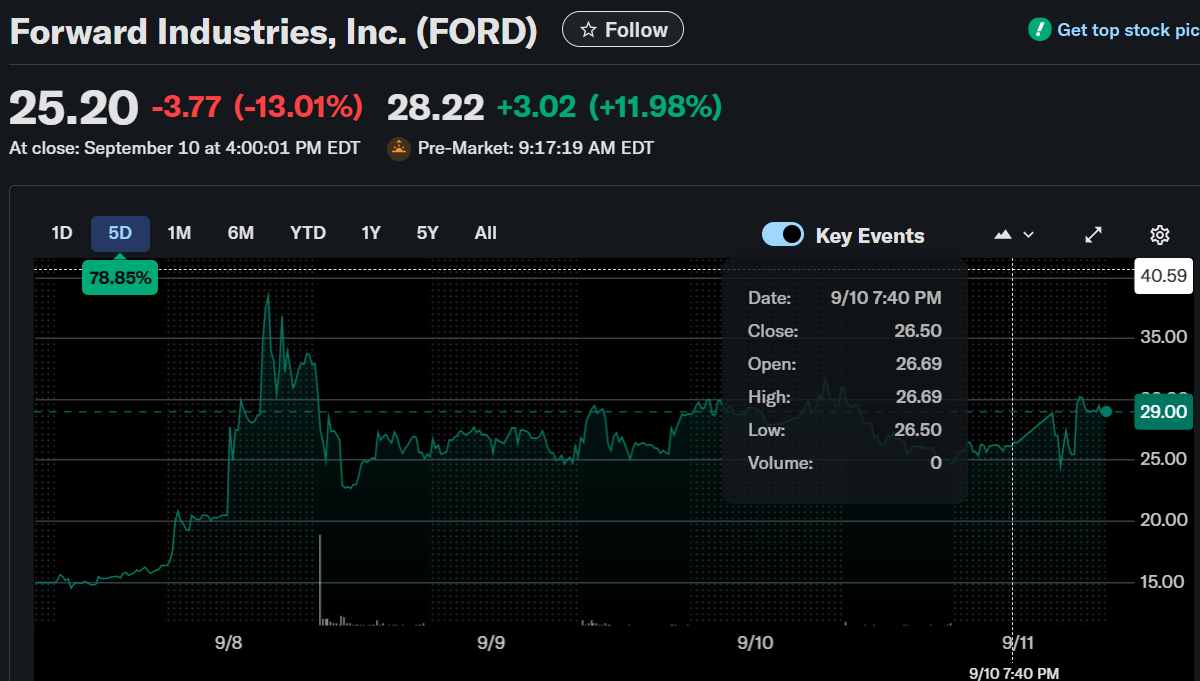
Forward Industries (FORD) Stock: Soars on $1.65B Solana-Focused PIPE Backed by Galaxy and Multicoin

Forward Industries (FORD) Stock: Soars on $1.65B Solana-Focused PIPE Backed by Galaxy and Multicoin

TLDR Forward Surges 13% After $1.65B Crypto Deal Led by Galaxy and Multicoin Forward Industries Bets Big on Solana With $1.65B Crypto Treasury Plan $1.65B Crypto Injection Sends Forward Soaring—Solana at the Core Forward Eyes Solana Dominance After $1.65B Backing From Crypto Giants PIPE Dream: Forward Rallies With $1.65B in Strategic Crypto Funding Forward Industries, [...] The post Forward Industries (FORD) Stock: Soars on $1.65B Solana-Focused PIPE Backed by Galaxy and Multicoin appeared first on CoinCentral.

Author: Coincentral
GENIUS Act Loophole Risks Draining Small Banks, Senator Warns

GENIUS Act Loophole Risks Draining Small Banks, Senator Warns

TLDR: Alabama Senator Keith Kelley says the GENIUS Act rewards loophole could reduce deposits in small rural banks. Crypto platforms offer high rewards without FDIC coverage, pulling funds away from community lending networks. Lower deposits could cut credit access for farms, small businesses, and rural economies dependent on local banks. Lawmaker urges Congress to close [...] The post GENIUS Act Loophole Risks Draining Small Banks, Senator Warns appeared first on Blockonomi.

Author: Blockonomi
Next Big Cryptocurrency Investors Are Hunting Could Be a DeFi Crypto That Already Touched $15.6M

Next Big Cryptocurrency Investors Are Hunting Could Be a DeFi Crypto That Already Touched $15.6M

The post Next Big Cryptocurrency Investors Are Hunting Could Be a DeFi Crypto That Already Touched $15.6M appeared first on Coinpedia Fintech News When the market feels crowded with large-cap plays, investors often begin hunting for DeFi infrastructure that is still in presale but already showing signs of strong momentum. While many traders are analyzing crypto charts and debating whether to enter familiar names, others are spotting opportunities in emerging protocols where the upside remains far larger. Mutuum …

Author: CoinPedia
Ethereum and Solana Lead Stablecoin Growth: What It Means for ETH and SOL Prices in 2025

Ethereum and Solana Lead Stablecoin Growth: What It Means for ETH and SOL Prices in 2025

The post Ethereum and Solana Lead Stablecoin Growth: What It Means for ETH and SOL Prices in 2025 appeared first on Coinpedia Fintech News Stablecoin flows are reshaping the crypto landscape, with Ethereum and Solana absorbing the majority of fresh supply in 2025. As these digital dollars drive liquidity into DeFi and payments, they directly impact gas usage, validator rewards, and ultimately the price trajectory of ETH and SOL. Can Ethereum’s stablecoin dominance push ETH price beyond $5,000, or …

Author: CoinPedia
From Fat Protocols to Fat Apps: Is Crypto Shifting Its Value Layer?

From Fat Protocols to Fat Apps: Is Crypto Shifting Its Value Layer?

Every cycle, crypto finds a new narrative that drives adoption — from ICOs to DeFi to NFTs. But in 2025, another contender is gaining traction: Fat Apps. These are not protocols, not just dApps, but heavyweight applications designed to dominate user attention and capture value at scale. What Are Fat Apps? In traditional Web3 discussions, value capture is often framed as “fat protocols” vs. “thin applications.” Fat Apps flip that thinking. They are: Applications with massive user networks. Built on top of existing blockchains. Designed to monetize data, liquidity, and user engagement directly. Instead of blockchain layers being the sole value driver, Fat Apps themselves could become the new giants. Why Fat Apps Could Be the Next Narrative User-first adoption: Retail users don’t care about L1 vs L2 — they care about apps that solve problems. Value capture: Fat Apps control front-end distribution, making them powerful gatekeepers. Ecosystem growth: As protocols compete for relevance, Fat Apps may dictate where liquidity flows. In many ways, the rise of Fat Apps echoes the Web2 model — think Facebook, Amazon, or Google — except now it’s on decentralized rails. Signals Already Emerging Some early signs suggest we’re entering a Fat Apps cycle: DeFi super-apps consolidating lending, swaps, and staking. SocialFi platforms where attention = tokenized value. Gaming ecosystems capturing users with built-in marketplaces. If this narrative takes off, the “winners” won’t just be protocols — they’ll be the apps that dominate user behavior. Fat Apps may sound like just another buzzword, but if history is a guide, new narratives drive cycles — and Fat Apps could be crypto’s next big story. We explored this in detail in our full editorial here: Fat Apps may sound like just another buzzword, but if history is a guide, new narratives drive cycles — and Fat Apps could be crypto’s next big story. We explored this in detail in our full editorial here: What Are Fat Apps in Crypto? From Fat Protocols to Fat Apps: Is Crypto Shifting Its Value Layer? was originally published in Coinmonks on Medium, where people are continuing the conversation by highlighting and responding to this story

Author: Medium