Liquidation

Liquidation occurs when a trader’s collateral is no longer sufficient to cover their leveraged position’s losses, triggering an automated forced closure by the exchange's liquidation engine. It is a critical risk-management mechanism that ensures the solvency of lending protocols and derivative platforms. In 2026, the focus has moved toward MEV-resistant liquidation models that protect users from predatory "cascades." This tag provides essential information on maintenance margins, health factors, and how to avoid liquidation in high-volatility environments.

15160 Articles
Created: 2026/02/02 18:52
Updated: 2026/02/02 18:52

In the past 24 hours, the total network contract liquidation was US$609 million, mainly due to the short position

In the past 24 hours, the total network contract liquidation was US$609 million, mainly due to the short position

PANews reported on October 9th that Coinglass data showed that over the past 24 hours, the cryptocurrency market saw $609 million in liquidated contracts across the network, including $187 million in long positions and $422 million in short positions. The total liquidation amount for BTC was $150 million, and for ETH, $175 million.

Author: PANews
Hyperliquid To Facilitate Futures Trading Through Metamask

Hyperliquid To Facilitate Futures Trading Through Metamask

The post Hyperliquid To Facilitate Futures Trading Through Metamask appeared on BitcoinEthereumNews.com. DeFi users can now execute futures long and short positions on Hyperliquid through their Metalmark wallets. This is courtesy of a recently announced Metalmark integration with Hyperliquid. Hyerliquid recently confirmed that users can now execute perpetual trades directly through Metalmark.  This was on account of the recent surge in crypto perps in the market. Source: X The announcement means users can execute leveraged long and short positions on Hyperliquid directly through their Metamask wallets. The announcement also reflected Hyperliquid’s deeper push into the decentralized Finance (DEFI) segment. Hyperliquid’s decision to facilitate perps trades directly through Metalmark highlights the DEX’s push towards more access. The move also emphasizes a safer approach for Metalmark users since they can access perps directly within the Metalmark ecosystem. The move highlighted MetaMask’s push towards more accessibility in the segment. It also underscored Hyperliquid’s growing role in the crypto segment, especially in boosting access to perps within decentralized ecosystems. The announcement also highlighted a milestone moment for the parties involved. Hyperliquid Liquidations Cross Yet Another Milestone Hyperliquid’s push towards Metaplanet integration also highlighted the surging demand for perps in the decentralized crypto segment. Cryptocurrencies such as Bitcoin have been pushing to new historic highs, but this has also triggered higher open interest. Consequently, top coins such as Bitcoin were more prone to leverage-induced volatility. This is because higher prices also invite more confidence, and depending on the level of profitability, this may either encourage more leveraged longs or short positions. Liquidations are usually higher during the exciting periods of the market. This appeared to be the case recently as cryptocurrencies such as Bitcoin and BNB pushed to new historic highs. According to the latest market data, total liquidations on Hyperliquid have so far exceeded $75 billion. Hyperliquid cumulative liquidation/ source: Hyperliquid Interestingly, Hyperliquid has been around…

Author: BitcoinEthereumNews
Ethereum’s network cooldown – Why caution doesn’t mean crisis!

Ethereum’s network cooldown – Why caution doesn’t mean crisis!

The post Ethereum’s network cooldown – Why caution doesn’t mean crisis! appeared on BitcoinEthereumNews.com. Key Takeaways  Why has Ethereum’s activity slowed recently? Internal Contract Calls slipped from 9.5 million, while Transaction Count and Network Growth declined sharply. Does this cooldown weaken Ethereum’s outlook? Not yet, as long as daily transactions stay above 1 million, Ethereum may hold structural strength before another upswing. Ethereum’s [ETH] on-chain momentum has slowed after months of elevated activity, with Internal Contract Calls falling from a sustained 9.5 million daily average.  The metric, which measures complex DeFi and RWA interactions, had reached new highs in September but now signals moderation. Despite continued optimism around ETF inflows and corporate accumulation, transactional depth has weakened, hinting that investors shifted from active accumulation to cautious observation as prior gains settled. Network growth and transactions retreat Santiment data highlighted a clear pullback in Ethereum’s Transaction Count, which dropped from around 1.6 million to 412K at press time. Likewise, Network Growth slipped from 150K to 37K, showing fewer new addresses joining the ecosystem.  The slowdown suggested lighter user onboarding after months of heavy engagement. Even so, such pullbacks often precede stabilization phases if core utility metrics remain steady. If sustained above 1 million daily transactions, Ethereum could maintain its structural strength despite current short-term fatigue among users. Source: Santiment Muted sentiment hints at quiet accumulation  At the time of writing, Ethereum’s Weighted Sentiment turned negative at –0.35 as Social Dominance hovered near 6.6%. The muted crowd response reflected cautious investor behavior following weeks of lower on-chain engagement.  Historically, negative sentiment often aligns with consolidation periods, allowing smart money to reposition during uncertainty.  However, the absence of a positive rebound suggests investors remain watchful, waiting for stronger fundamental or price catalysts before reentering the market with conviction. Source: Santiment Volatility clusters around key liquidation zones CoinGlass data revealed dense liquidation bands between $4,400 and $4,600 on…

Author: BitcoinEthereumNews
Monero up 8.7%, Bitcoin down 3.48% – Can XMR keep outperforming BTC?

Monero up 8.7%, Bitcoin down 3.48% – Can XMR keep outperforming BTC?

The density of liquidation levels around $350 meant that XMR was highly likely to move upward.

Author: Coinstats
FOMC Meeting Today [LIVE] Updates

FOMC Meeting Today [LIVE] Updates

The post FOMC Meeting Today [LIVE] Updates appeared first on Coinpedia Fintech News October 9, 2025 12:44:19 UTC Bowman Highlights Flexible Fed Policy Amid Cooling Labor Market In her October 9 FOMC opening remarks, Michelle Bowman emphasized that the Fed’s monetary policy framework remains data-dependent. She pointed to a cooling but stable labor market and inflation gradually returning to the 2% target, providing leeway for policy adjustments. The …

Author: CoinPedia
Why Mutuum Finance Is The Next Crypto To Explode As IBIT Sets Record as BlackRock Top-Earning ETF in History

Why Mutuum Finance Is The Next Crypto To Explode As IBIT Sets Record as BlackRock Top-Earning ETF in History

BlackRock’s iShares Bitcoin Trust has just shattered records by becoming the firm’s highest-earning exchange-traded fund ever. This crypto ETF pulled in over $244 million in yearly revenue within less than two years. Moreover it sits mere billions from hitting $100 billion in assets under management a feat no other ETF has matched so swiftly. As [...] The post Why Mutuum Finance Is The Next Crypto To Explode As IBIT Sets Record as BlackRock Top-Earning ETF in History appeared first on Blockonomi.

Author: Blockonomi
Logical analysis of the start, run and end of this round of BTC bull market: Has the four-year late rule been broken?

Logical analysis of the start, run and end of this round of BTC bull market: Has the four-year late rule been broken?

Author: 0xWeilan According to Coinbase, BTC reached a four-year low of $15,460.00 per coin on November 21, 2022. We regard this day as the end of the previous cycle and the beginning of this cycle. From that date until September 30th of this year, BTC has been volatile for 1,044 days, approaching the peak of the previous two cycles (approximately 1,060 days after the low point). Using a simplistic calculation, BTC will reach the peak of this cycle in October 2025. Comparison of BTC price trends over 5 cycles This "cyclical" curse of Bitcoin stems from the speculative frenzy driven by the spread of consensus and the production cuts. It remains the most important cyclical indicator for traditional large Bitcoin holders. This group has played a decisive role in shaping past Bitcoin tops. It is this group's frantic profit-taking and selling, which drains liquidity and ultimately leads to the market's peak. Currently, this group is accelerating their selling, suggesting a peak is imminent. However, other indicators of a top, such as a sharp rise in prices and a surge in new addresses, have not materialized. This raises questions: will this "cyclical law" continue to suppress the market, shaping a peak, or will it expire? Will the BTC bull market, which began in November 2022, end in October? In this report, EMC Labs uses its proprietary "BTC Cycle Multi-Factor Analysis Model" to conduct a comprehensive analysis of BTC price trends since this cycle, clarifying which market forces and underlying logic truly drive the cycle, and ultimately providing our analysis and judgment on whether BTC prices will peak in October. Phase 1 (November 2022~September 2023): Long-term holdings Looking back, the bankruptcy of FTX, one of the major buyers in the previous cycle, and its lender, Voyager Digital, marked the completion of the cycle's liquidation. Following FTX's bankruptcy, the BTC price plummeted from the bottom of its range of $20,000 to $15,476 (according to Coinbase data, the same applies hereafter), with its lowest point occurring on November 21, 2024. The bankruptcy of institutions like FTX hastened the market bottom, but the fundamental force that determines the end of the cycle is the profit-taking and selling of long-term investors. When the market is in a frenzy, short-term investors buy while long-term investors sell, and when the market cools, short-term investors sell while long-term investors increase their holdings. Statistics on changes in long-term group positions in the previous period As in previous cycles, long-term investors began accumulating shares during the bear market phase of the previous cycle. As the market entered the bottom phase, the scale of short-term losses began to decrease, and the buying power of long-term investors began to drive prices upward, pushing BTC and the crypto market out of the bottom and into a new cycle. Meanwhile, the Federal Reserve's post-pandemic interest rate hike cycle is nearing its end, officially concluding on July 26, 2023. Due to forward trading, the Nasdaq Composite Index bottomed out on October 13, 2022, and broke out of its lower range in January 2023. Bitcoin prices have roughly tracked this trend, approximately 9-10 months before the official halt in interest rate hikes. As the interest rate hike cycle nears its end, tightening monetary policy has led to bankruptcies at regional US banks (Silicon Valley Bank and First Republic Bank), forcing the US government to urgently release liquidity. The US M2/DXY index has begun to rebound, providing an external environment for a bottoming-out rebound in the US stock market and Bitcoin. US M2/DXY We define "November 2022-September 2023" as the first phase of this cycle. Coupled with improvements in macro liquidity, the tension generated by the internal holding structure of the crypto market will become the fundamental driving force behind BTC price increases during this phase. The Fed's interest rate hikes officially ended in July 2023, and long-term holdings continued until the end of September 2023. The DATs and BTC Spot ETFs, which would later become influential, had yet to become dominant forces, and retail investors, driven by rising and falling prices, had not yet awakened. During this period, stablecoin issuance was shrinking, and capital was still flowing out of the crypto market. Periodic increases in holdings by long-term investors were the primary driver of the market's upward trend. In the first stage, BTC rebounded from a low of $15,476.00 to a high of $31,862.21, with a maximum increase of 105.88%. Phase 2 (October 2023-March 2024): BTC Spot ETF U.S. inflation continued to decline, and the brief rebound in CPI from July to September 2023 was considered a false alarm. July was finally confirmed as the end month of the Fed's current interest rate hike cycle. As market expectations change, risky assets begin to be favored by funds. The change in risk appetite has prepared BTC for the launch of the second phase of the market. US CPI What really drives BTC to start the second phase of this cycle is the expected approval of the BTC Spot ETF and the fifth BTC halving in April 2024. Traditional Wall Street asset management giants such as BlackRock and Fidelity submitted BTC Spot ETF applications to the SEC in June 2023, and forward-looking speculative trading funds were secretly gathered. Taking the SEC's approval of the BTC Spot ETF on January 10, 2024 as the dividing line, the second stage of the market is divided into the first and second halves. The first half (2023.10~2024.01.10) is dominated by speculative funds betting on the ETF approval, and the second half (2024.01.10~2024.03.14) is dominated by incremental funds brought by the ETF channel (over US$12 billion). Monthly statistics on fund flows in BTC Spot ETF and stablecoin channels In addition, the stablecoin channel completely got rid of the outflow trend in October and resumed inflow. By the end of March, the total new issuance exceeded US$26 billion, which was one of the main driving forces in the first half. Since the start of this phase of the market in October 2024, the long-term holding group began to reduce their holdings, and by the end of the market, the scale of reduction reached as much as 900,000 pieces. The market during this period was driven by speculative/investment funds within the BTC Spot ETF channel, on-exchange speculative/investment funds (manifested by a large increase in stablecoin issuance), and long-term selling. Buying power outweighed selling pressure, driving a sharp and aggressive rise in BTC prices. In the second stage, BTC rose from a low of $26,955.25 to a high of $73,835.57, with a maximum increase of 173.92%. Phase 3 (April 2024~September 2024): Halving and Rebalancing In our second-phase analysis, we noted that investment and speculative capital based on the traditional narrative of Bitcoin production cuts was also a significant factor in determining market trends. This was clearly reflected in the third-phase market trends. On April 19, 2024, Bitcoin completed its fourth halving, reducing the block reward from 6.25 BTC to 3.125 BTC. Although over 95% of BTC has already entered circulation, significantly reducing the impact of the halving on actual market supply, the speculation surrounding the halving did indeed overdraw BTC's upward potential. From April to September 2024, BTC entered a seven-month period of volatile adjustments. Funding statistics show that after BTC reached a temporary peak in March, the scale of capital inflows into the BTC Spot ETF channel shrank but remained at a high level. However, the stablecoin channel shrank even more, and even turned to outflow at one point. Monthly statistics on fund flows in BTC Spot ETF and stablecoin channels During this period, although the Federal Reserve has stopped raising interest rates, it has not yet started to cut interest rates. The scale of fund inflows into the ETF channel has decreased significantly. In addition, on-site funds have left the market with the arrival of the halving. The overdrawn market has to be revised downward to seek a new price balance. The market was able to rebalance, avoiding a bear market, thanks to the stabilizing force of the long-term holding group. We noticed that after April, as liquidity receded, long-term holders stopped reducing their holdings, and then began increasing their holdings after July. This behavior of long-term holders is consistent with the group's past behavior, marking a temporary bottom for the market. In the third stage, the highest price was $109,588, the lowest price was $74,508, and the maximum drop was 32.01%, which did not exceed the BTC bull market correction threshold. Phase 4 (October 2024-January 2025): Trump’s Crypto-Friendly Policies After halting interest rate cuts in July 2023, the federal funds rate remained elevated at 5.25-5.50 to suppress a decline in the CPI. High interest rates gradually undermined the job market, prompting the Fed to resume cutting rates at its September 2024 meeting, completing a 75 basis point reduction by the end of the year. Interest rate cuts have boosted risk appetite across the market, leading to a massive influx of funds into the crypto market through BTC Spot ETFs and stablecoin channels. By the end of January 2025, 11 BTC Spot ETFs in the United States had assets under management exceeding $100 billion, setting multiple historical records. This demonstrates that the BTC "digital gold" narrative has gained favor on Wall Street, and BTC is transitioning from an alternative asset to a mainstream one. In addition to interest rate cuts, another catalyst for BTC's rise was the US presidential election. During this campaign, Republican candidate Donald John Trump's attitude towards cryptocurrencies changed 180 degrees, becoming the most "crypto-friendly" presidential candidate in the United States. His family business even issued the MEME token Trump after his victory. Since taking office, Trump has signed executive orders supporting digital assets and blockchain technology, established an interagency working group to review existing regulatory policies, announced the establishment of a "Bitcoin Strategic Reserve" and a "U.S. Digital Asset Reserve," and signed the GENIUS Act to promote the compliant development of stablecoins. Furthermore, he has appointed "crypto-friendly" individuals to the positions of Secretary of the Treasury and Chairman of the SEC, effectively promoting the development of crypto assets and blockchain technology in the United States. This level of friendly attitude and intensive policymaking is unprecedented, and even Satoshi Nakamoto would find it unbelievable. With the Trump campaign, massive amounts of funds were rapidly injected into the crypto market through ETFs and stablecoins, forming the largest capital inflow so far in this cycle. At the same time, long-term investors once again started selling to lock in profits. Statistics on the value realization of the BitNetwork chain Driven by crypto-friendly policies in the United States, crypto assets are gradually becoming mainstream assets in the country. In addition to the BTC Spot ETF, dozens of DATs, represented by Strategy, have joined the race to accumulate BTC and other crypto assets. These two groups have become the largest buyers of BTC. BTC Spot ETF and DATs companies hold more than or close to 5% of BTC. With the massive entry of the BTC Spot ETF and DATs, BTC is entering a period of significant turnover. Large amounts of BTC are being transferred from early holders into the custody accounts of BTC Spot ETFs and DATs. This has caused a significant decline in the amount of BTC held on centralized exchanges, a common practice among early crypto holders. By the end of September 2025, over 400,000 BTC had flowed out of centralized exchange management addresses, representing a value of over $40 billion at $100,000 per BTC. BTC inventory statistics of major crypto asset exchanges This outflow continued during and after this phase, demonstrating that BTC is currently undergoing a historic turnover. Early investors (including those who have held for more than seven years) are cashing out significant profits, while traditional funds are transitioning to long-term investors in the asset. The behavior of early investors is significantly influenced by the halving cycle, while DATs appear to favor continuous buying and long-term holding. The behavior of holders of the BTC Spot ETF channel is more influenced by US stock market trends. This change in the coin holding structure makes the BTC cycle more complicated. The market momentum during this period came from speculation brought about by interest rate cuts and expectations of Trump's crypto-friendly policies, and the crypto market received record capital inflows during this period. In the fourth stage, the BTC price rose from a low of $63,301.25 to $109,358.01 (recorded on January 20, 2025, the day Trump took office), with the maximum increase reaching 72.76%. Phase 5 (February 2025~April 2025): Black Swan In our research framework, the fifth phase represents another mid-term adjustment, triggered by external black swan events and a resurgence of sentiment following enthusiastic speculation. The market turmoil unleashed by the pause in interest rate cuts and the tariff war reached a threshold both in terms of time and space, ultimately forming this unique phase. Monthly statistics on crypto market capital flows Because the US stock and crypto markets had already fully priced in continued interest rate cuts, when the Federal Reserve stopped cutting rates in January 2025 and refocused on reducing inflation, the historically high US stock and Bitcoin prices entered a precarious situation. When Trump announced tariffs far exceeding expectations, the market plummeted. The Nasdaq's maximum correction from its peak was nearly 17%, while BTC's maximum correction reached 32%. While BTC's decline was significant, it still did not exceed BTC's correction threshold in a bull market. Ultimately, as the panic caused by the tariff war and concerns about a hard landing of the US economy subsided, both the US stock market and the crypto market achieved a V-shaped reversal in April and continued to set new historical highs after July. Behind the V-shaped reversal, funds from DATs companies, BTC Spot ETF channels and stablecoin channels rushed to buy shares. In addition, the long-term holding group returned to increase holdings in a timely manner after the decline, once again playing the role of a market stabilizer. In the fifth stage, the highest price was $73,777, the lowest price was $49,000, and the maximum drop was 33.58%, which did not exceed the scale of the BTC bull market correction. Phase 6 (May 2025~): Old Cycle and New Cycle The market crash caused by the black swan was gradually recovered by bargain-hunting funds and long-term holdings. By July, BTC had hit a historical high of $123,000. At this point, the long-term investors initiated the third major sell-off of this cycle, which continues to this day. The investors were DATs and BTC Spot ETF channel funds. Before the September rate cut, forward-looking trading continued to dominate the market. From July to September, funds inflows surged, but the scale of inflows gradually decreased, leading to a slight correction in BTC after the rate cut. Long-term divestment became the primary activity influencing market movements. BTC long-term holdings statistics Since the beginning of this cycle, accompanied by the third wave of price increases, long-term investors have been engaged in a third round of large-scale selling. According to on-chain data, long-term investors have locked in profits exceeding 3.5 million BTC during this cycle, a figure that has already reached the threshold reached at the top of previous cycles. As of today, long-term investors are still continuing to sell off BTC significantly. BTC long-term profit statistics (BTC) In previous bull-bear cycles triggered by Bitcoin halvings, the reduction in Bitcoin production and the accumulation and distribution of long-term holdings were the decisive factors in the formation of the cycle. The speculative sentiment surrounding the production cuts, driving the entry of new investors, was a necessary condition for the formation of the cycle top. In previous cycles, this influx of new speculators manifested itself as a surge in new addresses in Bitcoin network wallets. However, as consensus on BTC spreads, the number of new addresses created by BTC in each cycle has stagnated. Since 2024, the number of new BTC addresses has fallen to levels seen during previous bear markets. Of course, this cannot simply be attributed to a decrease in new entrants. After the approval of 11 BTC Spot ETFs in the United States in January 2024, many investors began using ETF channels to participate, significantly reducing the creation of BTC wallet addresses. Statistics of new addresses added to BitNet But when looking at Ethereum, the largest SCP platform, we can notice the same pattern in terms of newly added addresses during this period. Ethereum new address statistics This leads us to believe that the BTC market structure has undergone a dramatic shift, and the entire crypto market is entering a new phase of development. Simply predicting market tops based on cyclical patterns or blindly buying into hot currencies in the hope of high returns are outdated. Even BTC may have already stepped out of the old cycle and entered a new cycle, and its peaking method, peaking time and bear market correction amplitude may change completely. Conclusion From the above review and observation, we have come to a preliminary conclusion: the driving force of this bull market mainly comes from the promotion of industrial policies and incremental funds from traditional channels. Production cuts and industrial innovation have failed to bring in huge capital inflows as in the past, thereby triggering a comprehensive bull market in the Crypto market with all currencies soaring. Although during this bull market, the industry has also seen innovations in niche areas such as Ethereum Layer 2, BTC Ordinals, Restaking, Solana Renaissance, and DePhin, compared with the previous ICO and DeFi craze, the funds attracted by these innovations are pulsed and extremely limited. As a result, since BTC restarted a new bull market cycle in November 2022, the prices of most coins and tokens in the crypto market have only seen pulsed, periodic increases. Even ETH, the SCP platform token with the largest consensus and the most use cases, saw its price fall back to the starting point of the bull market in 2025. BTC is emerging from its old cycle and entering a new one. Driven by market sentiment and their own logic, funds from DATs and the BTC Spot ETF are attempting to reshape the logic and form of the cycle. However, the group of long-term BTC holders, who have played a decisive role in the cyclical movement over the past 16 years, still holds over 15 million BTC, representing 70% of all issued BTC, and this group continues to act according to the cyclical law. Factors supporting the fact that the market has not yet peaked or even entered a new cycle include: DATs companies' outstanding fundraising capabilities and long-term holding strategies, the United States is still introducing and implementing crypto-friendly policies, and the high-risk asset allocation trend caused by the restart of the interest rate cut cycle. Will long-term investors diligently squeeze out liquidity to complete the top of the old cycle, or will buying power in an interest rate cut environment bury selling pressure and follow the US stock market into a new long bull cycle? This game is still ongoing. We believe the cycle will be extended. While a BTC peak in October remains a low probability event, if long-term investors continue to sell, the bull market will likely end this year. The length and scope of the subsequent bear market correction could be significantly reduced, depending on the behavior of new buyers. The end has begun.

Author: PANews
Why IPO Genie Could Be the Best Crypto Presale to Invest in 2025 as Crypto Liquidations Hit $1.8B Last Month

Why IPO Genie Could Be the Best Crypto Presale to Invest in 2025 as Crypto Liquidations Hit $1.8B Last Month

With traders shaken by massive liquidations in the last week of September, IPO Genie’s AI Utility Token presale offers a scarcity-driven play with real utility, private market access, AI deal discovery, and staking rewards. Over $1.8 billion was gone in a day in the last week of September. That’s what happened when Bitcoin slid below […] The post Why IPO Genie Could Be the Best Crypto Presale to Invest in 2025 as Crypto Liquidations Hit $1.8B Last Month appeared first on Live Bitcoin News.

Author: LiveBitcoinNews
What If Satoshi’s $100B Bitcoin Moves? Here’s What Could Happen

What If Satoshi’s $100B Bitcoin Moves? Here’s What Could Happen

The post What If Satoshi’s $100B Bitcoin Moves? Here’s What Could Happen appeared on BitcoinEthereumNews.com. Overview of Satoshi’s background holdings Bitcoin was created in 2009 by the pseudonymous Satoshi Nakamoto, whose identity remains unknown. Between 2009 and 2011, Satoshi mined an estimated 1.1 million-1.5 million BTC — now worth over $100 billion — which has never been moved. Satoshi’s massive Bitcoin (BTC) holdings were mined in Bitcoin’s early days, when competition was low and mining was easy. Their long silence has fueled speculation. Some believe the private keys are lost, while others see it as a deliberate decision to uphold Bitcoin’s ideals or avoid market disruption. If Satoshi’s Bitcoin were ever moved, it could have a major impact on prices and investor confidence. Its continued dormancy shows Bitcoin’s strength as a decentralized system. It also keeps alive the mystery around Satoshi’s intentions, which continues to interest investors and crypto enthusiasts. Did you know? Bitcoin’s journey began on Jan. 3, 2009, when Satoshi Nakamoto mined the first block, known as the genesis block. Embedded in its code was a message referencing a Times headline about bank bailouts, highlighting Bitcoin’s purpose as an alternative to the traditional financial system. Potential triggers for the movement of Satoshi’s Bitcoin holdings Satoshi Nakamoto’s Bitcoin stash, estimated at 1.1 million-1.5 million BTC, has remained untouched since 2009-2011. This silence has fueled ongoing curiosity about what might one day trigger its movement. Analysts and crypto enthusiasts suggest several possible reasons: Personal financial needs: Satoshi, or anyone with access, might need funds for a venture or to transfer assets to heirs, prompting a partial liquidation of the stash. Ideological motives: The coins could be moved to make a statement, either to reinforce Bitcoin’s decentralization or to influence market dynamics strategically. Recovery of private keys: If previously lost keys were recovered, the stash could suddenly become accessible. External pressures: Governments might issue legal demands,…

Author: BitcoinEthereumNews
Dogecoin (DOGE) Price Jumps Following Nvidia CEO Comments on Elon Musk Partnership

Dogecoin (DOGE) Price Jumps Following Nvidia CEO Comments on Elon Musk Partnership

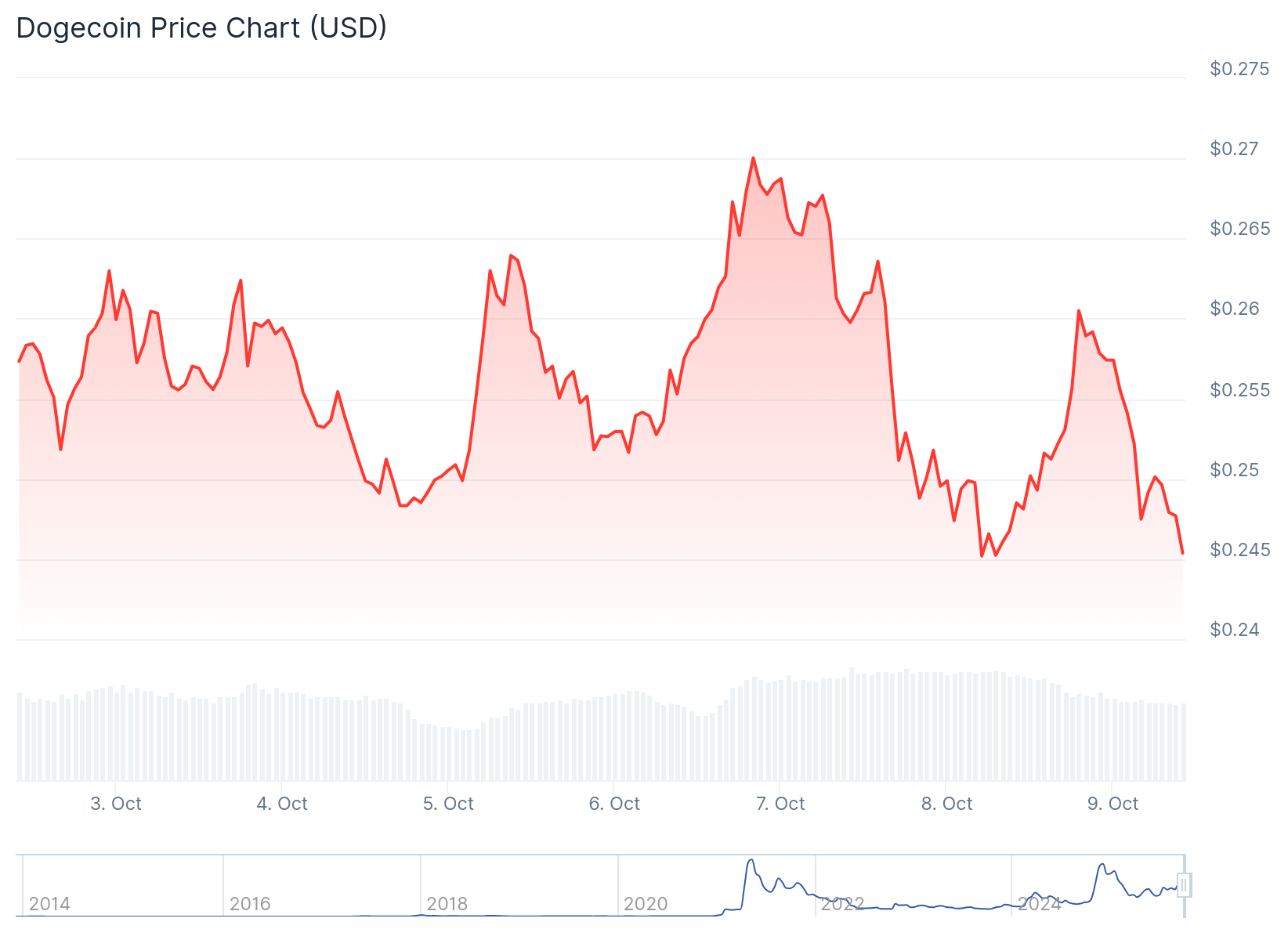
TLDR Dogecoin price jumped 2% after Nvidia CEO Jensen Huang said he wants to follow Elon Musk in everything Whales moved nearly $100 million worth of DOGE in the last 24 hours with continued accumulation Token hit resistance at $0.26 and pulled back to $0.253 after institutional profit-taking Large holders added 30 million DOGE tokens [...] The post Dogecoin (DOGE) Price Jumps Following Nvidia CEO Comments on Elon Musk Partnership appeared first on CoinCentral.

Author: Coincentral