Oracle

Oracles are essential infrastructure components that feed real-time, off-chain data (such as price feeds, weather, or sports results) into blockchain smart contracts. Without decentralized oracles like Chainlink and Pyth, DeFi could not function. In 2026, oracles have evolved to support verifiable randomness and cross-chain data synchronization. This tag covers the technical evolution of data availability, tamper-proof price feeds, and the critical role oracles play in ensuring the deterministic execution of complex decentralized applications.

5133 Articles
Created: 2026/02/02 18:52
Updated: 2026/02/02 18:52
Oracle Health Achieves QHIN Designation, Enhancing Data Interoperability

Oracle Health Achieves QHIN Designation, Enhancing Data Interoperability

The post Oracle Health Achieves QHIN Designation, Enhancing Data Interoperability appeared on BitcoinEthereumNews.com. Terrill Dicki Nov 21, 2025 09:21 Oracle Health secures a Qualified Health Information Network designation under TEFCA, reinforcing its leadership in healthcare data interoperability and offering seamless data exchange across the ecosystem. Oracle Health, a subsidiary of Oracle, has been recognized as a Qualified Health Information Network (QHIN) under the Trusted Exchange Framework and Common Agreement (TEFCA), according to oracle.com. This designation marks a significant milestone in Oracle Health’s efforts to lead the charge in healthcare data interoperability, facilitating secure and standardized health information exchange nationwide. Empowering Healthcare with Interoperability The Oracle Health Information Network is designed to simplify the complexities of data interoperability for healthcare providers. By leveraging Oracle Cloud Infrastructure (OCI), the network offers robust scalability, security, and performance, enabling efficient health data sharing and reducing reliance on third-party technologies. This initiative aligns with Oracle’s broader commitment to supporting the Centers for Medicare and Medicaid Services’ Digital Health Ecosystem and Interoperability Framework. Seema Verma, Executive Vice President and General Manager of Oracle Health and Life Sciences, emphasized the importance of data interoperability, stating, “Becoming a Designated QHIN marks another milestone in Oracle’s commitment and investment to enable safe and secure interoperability that puts patients first.” She highlighted the potential of interoperability to enhance healthcare outcomes by harnessing AI, improving care quality, and scaling value-based care. Streamlining Healthcare Data Exchange With the QHIN designation, Oracle Health customers gain a unified point of connectivity across the healthcare ecosystem, eliminating the need for multiple exchange networks. This integration not only provides a comprehensive view of patient health but also reduces redundant testing and clinical processes. The Oracle Health Information Network supports seamless data exchange, allowing for improved care decisions and streamlined authorizations and reimbursements. Oracle Health customers can participate in the network for…

Author: BitcoinEthereumNews
Chainlink Anchors Tokenization as LINK Defends $11.65

Chainlink Anchors Tokenization as LINK Defends $11.65

The post Chainlink Anchors Tokenization as LINK Defends $11.65 appeared on BitcoinEthereumNews.com. Grayscale Research has released a new report arguing that Chainlink’s technology now sits at the center of efforts to connect public blockchains with traditional financial infrastructure. The paper, titled “The LINK Between Worlds,” describes Chainlink as “critical connective tissue” between on-chain and off-chain systems and says its software could be essential for tokenization and decentralized finance (DeFi). Chainlink Positioned as Core Plumbing for Tokenization In the report, Grayscale analysts say public blockchains cannot support large-scale finance unless they reliably talk to real-world data and existing institutions. Chainlink’s tools, they argue, provide that missing connection layer for everything from asset prices to settlement events. Chainlink Tokenization Bridge. Source: Grayscale  on X The research notes that most financial assets still live off-chain today. Tokenized versions account for only about 0.01% of the combined value of global equity and bond markets, leaving “enormous” room for expansion as more instruments move onto blockchains. Tokenized Assets Market Comparison. Source: Grayscale Research Because of this gap, Grayscale frames Chainlink’s role in tokenization as primarily infrastructure. The network’s data feeds, automation tools and cross-chain messaging are presented as the rails that can let banks, asset managers and market utilities interact with public blockchains while keeping existing processes and controls. From ‘Oracle’ to Modular Middleware The report pushes back on the idea of Chainlink as only a price-feed “oracle.” Instead, Grayscale describes it as modular middleware that lets smart-contract applications safely pull in outside information, talk to other blockchains and meet compliance requirements. Under this framing, Chainlink’s oracle networks are one component of a broader stack. The paper highlights features such as cross-chain communication, which can move messages and value between different networks, and services that can help institutions meet reporting or audit needs when they interact with DeFi protocols. According to Grayscale, this middleware approach means developers…

Author: BitcoinEthereumNews
Grayscale Calls Chainlink Key Bridge Between Crypto and Traditional Finance as LINK Tests $11.65 Floor

Grayscale Calls Chainlink Key Bridge Between Crypto and Traditional Finance as LINK Tests $11.65 Floor

Grayscale Research has released a new report arguing that Chainlink’s technology now sits at the center of efforts to connect public blockchains with traditional financial infrastructure. The paper, titled “The LINK Between Worlds,” describes Chainlink as “critical connective tissue” between on-chain and off-chain systems and says its software could be essential for tokenization and decentralized finance (DeFi).Chainlink Positioned as Core Plumbing for TokenizationIn the report, Grayscale analysts say public blockchains cannot support large-scale finance unless they reliably talk to real-world data and existing institutions. Chainlink’s tools, they argue, provide that missing connection layer for everything from asset prices to settlement events. Chainlink Tokenization Bridge. Source: Grayscale  on XThe research notes that most financial assets still live off-chain today. Tokenized versions account for only about 0.01% of the combined value of global equity and bond markets, leaving “enormous” room for expansion as more instruments move onto blockchains. Tokenized Assets Market Comparison. Source: Grayscale ResearchBecause of this gap, Grayscale frames Chainlink’s role in tokenization as primarily infrastructure. The network’s data feeds, automation tools and cross-chain messaging are presented as the rails that can let banks, asset managers and market utilities interact with public blockchains while keeping existing processes and controls. From ‘Oracle’ to Modular MiddlewareThe report pushes back on the idea of Chainlink as only a price-feed “oracle.” Instead, Grayscale describes it as modular middleware that lets smart-contract applications safely pull in outside information, talk to other blockchains and meet compliance requirements. Under this framing, Chainlink’s oracle networks are one component of a broader stack. The paper highlights features such as cross-chain communication, which can move messages and value between different networks, and services that can help institutions meet reporting or audit needs when they interact with DeFi protocols.According to Grayscale, this middleware approach means developers and financial firms do not need to rebuild their systems from scratch. Instead, they can plug existing workflows into Chainlink-enabled applications that run on multiple blockchains, while the middleware handles connectivity and verification in the background.LINK Token Presented as Broad Crypto-Market ExposureThe research also focuses on the LINK token’s place inside Grayscale’s sector framework. It classifies LINK as the largest asset in the “Utilities & Services” crypto sector by market value and the biggest non-Layer 1 token in the market when stablecoins are excluded. LINK Price Chart. Source: Artemis / Grayscale ResearchBecause Chainlink supports many blockchains rather than a single network, the report says LINK offers exposure to activity across the wider crypto economy. In that view, demand for LINK could track usage of Chainlink services on Ethereum, layer-2 networks and non-EVM chains that rely on its middleware. Grayscale concludes that this combination of cross-chain reach, tokenization focus and infrastructure usage makes LINK a candidate for diversified crypto portfolios, placing it alongside larger assets such as bitcoin and ether in the firm’s internal sector analysis.Trader Flags $11.65 as Critical LINK Support ZoneMeanwhile, Rick Barber says Chainlink has dropped into what he views as the macro support line and bottom of his buy range. In his post, he notes that this level has acted as support since 2024 and that several indicators now cluster around the same area, giving him confluence for a potential bottom. He adds that, for his spot position, the key risk would be a daily close below roughly $11.65.Chainlink Macro Support Zone. Source: Rick Barber on XOn the 4-hour chart, LINK trades near 12 dollars inside a highlighted green demand zone, with price pressing against horizontal support and a dense volume profile band just above. Meanwhile, oscillators such as RSI and MACD sit near the lower end of their recent ranges, reflecting extended downside pressure after a steady series of lower highs. The chart also shows price trading below major moving averages, underlining that the short-term trend remains weak even as it approaches support.On the daily timeframe, Barber’s chart extends that zone back through prior reactions, with LINK again testing the same band that previously acted as a base for rallies. In addition, a rising trendline from earlier lows runs just beneath the current range, reinforcing the idea of a long-term support cluster. However, the daily RSI continues to trend down, and Barber warns that a decisive break and close under the $11.65 area would invalidate his support thesis and raise concern about further downside.

Author: Coinstats
BNB Chain Gains Circle’s USYC as Developers Tap New Yield-Accruing Collateral

BNB Chain Gains Circle’s USYC as Developers Tap New Yield-Accruing Collateral

Circle has added its tokenized money market fund, USYC, to BNB Chain, opening a new path for eligible developers who want to use yield-accruing collateral across the network’s active DeFi ecosystem. The move gives non-US institutional users access to a regulated product that behaves like a traditional money market fund but operates fully on-chain, with […]

Author: Tronweekly
This $0.035 New Crypto Is Selling Out Fast, Could It Be the Best Crypto to Buy Before 2026?

This $0.035 New Crypto Is Selling Out Fast, Could It Be the Best Crypto to Buy Before 2026?

Increasingly, investors are no longer focusing on the large cap, which moves slowly but steadily, but looking at up-and-coming crypto projects expressing actual momentum. A single token is sweeping the market in a fashion not anticipated by many, and it is starting to gain traction in an unexpected rapidity, with many of its early adopters […]

Author: Cryptopolitan
Oracle Recognized as Market Leader in Workforce Management by ISG

Oracle Recognized as Market Leader in Workforce Management by ISG

The post Oracle Recognized as Market Leader in Workforce Management by ISG appeared on BitcoinEthereumNews.com. Ted Hisokawa Nov 21, 2025 07:41 Oracle is named a Market Leader in the 2025 ISG Buyers Guide for Workforce Management, highlighting its innovative solutions in workforce management technology. Oracle has been acknowledged as a Market Leader in the 2025 ISG Buyers Guide for Workforce Management, according to oracle.com. This recognition underscores Oracle’s commitment to advancing workforce management technology in a rapidly evolving labor market. Oracle’s Leadership in Workforce Management The ISG Buyers Guide highlighted Oracle’s exemplary performance in meeting both product and customer experience requirements. Oracle Workforce Management, a component of Oracle Fusion Cloud Human Capital Management (HCM), was distinguished as the only software provider to achieve leadership status in all seven evaluated categories, including adaptability, capability, manageability, reliability, usability, total cost of ownership/return on investment, and software provider validation. This accolade reinforces Oracle’s leadership across industries with complex workforce demands. The company’s AI-powered insights and native integrations with Oracle Fusion Cloud Enterprise Resource Planning (ERP), Supply Chain & Manufacturing (SCM), and Oracle Health provide HR and business leaders with the tools needed to optimize workforce planning and align schedules with business goals. Industry-Specific Innovations and Future Plans Oracle’s solutions are trusted by organizations in diverse sectors such as healthcare, manufacturing, retail, and the public sector. Features like shift swap options, predictive scheduling, and AI-assisted forecasting are designed to streamline scheduling and improve labor forecasting. Looking forward, Oracle plans to expand its capabilities further, deepen industry-specific features, and enhance intelligence across the workforce lifecycle. This strategic focus aims to empower organizations to unlock the full potential of their workforce. About Oracle Fusion Cloud HCM Oracle Fusion Cloud HCM is part of Oracle Fusion Cloud Applications. It offers a comprehensive solution connecting all human resource processes from hire to retire with a…

Author: BitcoinEthereumNews
U.S. stocks closed higher across the board, with Circle (CRCL) rising more than 6%.

U.S. stocks closed higher across the board, with Circle (CRCL) rising more than 6%.

PANews, November 22nd - According to Cailian Press, the three major U.S. stock indexes closed higher across the board: the Dow Jones Industrial Average rose 1.08%, the S&P 500 rose 0.98%, and the Nasdaq Composite rose 0.88%. The Nasdaq has fallen 2.74% this week, the S&P 500 has fallen 1.95%, and the Dow has fallen 1.91%. Large-cap tech stocks showed mixed performance: Google rose over 3%, Intel rose over 2%, Apple and Amazon rose over 1%, Oracle fell over 5%, and Netflix, Microsoft, AMD, Nvidia, and Tesla fell over 1%. Blockchain concept stocks generally rose, with Circle (CRCL) rising 6.57% and Coinbase (COIN) rising 0.94%.

Author: PANews
RWA TVL Hits New All-Time High as Tokenization Wave Accelerates in November

RWA TVL Hits New All-Time High as Tokenization Wave Accelerates in November

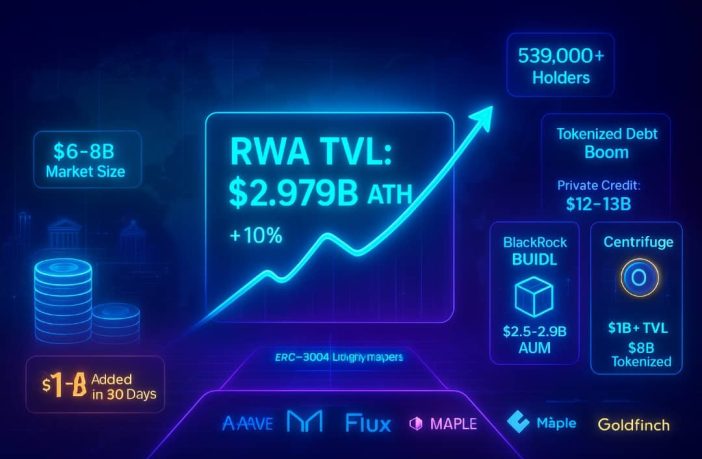
The tokenized Real World Asset (RWA) market continues its rapid climb, closing November with another major milestone. Total on-chain RWA TVL has reached $2.979 billion, marking a 10% month-over-month jump and signaling intensifying adoption across institutional and DeFi rails. According to data from rwa.xyz, the sector now records more than 539,000 unique holders, underscoring the [...]

Author: Null TX
As Crypto Matures, Centralization Creeps Back Into the System

As Crypto Matures, Centralization Creeps Back Into the System

The value of tokenized real-world assets has grown almost fivefold in three years. Wall Street is absorbing blockchain while preserving its power structures. The problem is marketing centralized infrastructure as decentralized innovation.

Author: Hackernoon
ROI Can’t Save Us: Why Today’s Money Fails at Humanity’s Biggest Problems

ROI Can’t Save Us: Why Today’s Money Fails at Humanity’s Biggest Problems

We don’t lack ideas or tools to clean up; we lack a monetary logic that funds non-ROI necessities at planetary scale. If we keep asking capital markets to solve problems that don’t return capital, we will keep getting underinvestment. The path forward is to redefine what we’re willing—and able—to finance, with mechanisms built for public goods rather than profits alone.

Author: Hackernoon